Investing in Wisconsin research
ICTR improves the health of communities across Wisconsin by making the research process smoother, faster, and more impactful. Supported by the flagship Clinical and Translational Science Award (CTSA) Program and the Wisconsin Partnership Program, we provide tailored services, training programs, and funding to help researchers successfully advance their research projects and careers. This investment makes it possible for new and better treatments to quickly reach our communities and clinics across the state.
Our support for researchers includes:
- Career development programs that promote rigorous, evidence-based research practices across many research disciplines.
- Centralized, coordinated expertise in all aspects of research design and development.
- Tools and technology for streamlining research operations and managing data.
- Guidance to ensure that research is responsive to community needs and that results can be effectively disseminated and used.
- Strong institutional partnerships to foster scalable, collaborative projects.
2025 in review
Below is a sampling of several high-impact ICTR projects. In 2024, ICTR provided support to over 1,500 research projects. Check back regularly to learn more about the impacts of our work. We invite you to explore more stories in our online newsroom, where you will also find an RSS feed of scholarly publications supported by our CTSA awards.
Seeking more information about the projects below, or other ICTR impacts? Reach out to our Communications Team: Communications Manager Jennifer Smith or Communications Specialist Lauren Neumann.
Real world impacts
Faster treatments and injury prevention in rural communities
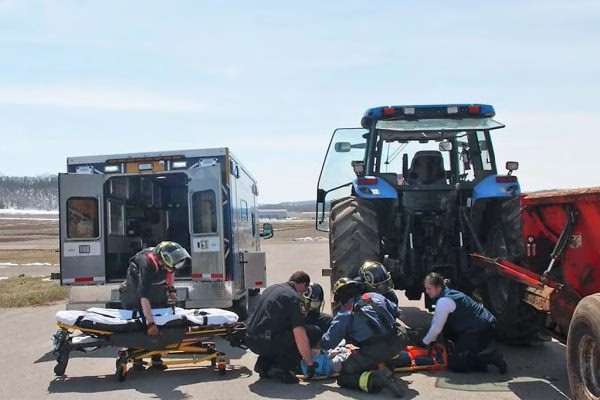
Researchers, firefighters, and farmers team up
Principal Investigator: Casper Bendixsen, PhD
People employed in agriculture face significant risks for injuries and fatalities, which cost communities across the U.S. billions of dollars each year. Researchers found that farmers trust rural firefighters to provide safety advice. The Rural Firefighters Delivering Agriculture Safety & Health (RF-DASH) program is a train-the-trainer program that equips first responders with agricultural health and safety knowledge to prevent farm injuries and improve emergency preparedness in rural communities.
With ICTR’s support*, RF-DASH doubled the program’s size in Wisconsin, extending its reach to volunteer firefighters throughout the state. To date, RF-DASH has directly trained more than 250 first responders and others from 17 U.S. states and 5 Canadian provinces. Additionally, RFDASH created an online course that utilizes 360-degree imagery to increase the program’s dissemination and impact.
Game-changing help for fungal disease
Principal Investigators: Alexandra Linz, PhD & Alana Sterkel, PhD
Rural Wisconsin is the global hotspot for blastomycosis, a life-threatening fungal infection. Yet current tests for this disease are difficult to run in rural clinical labs. This delays treatment, which can lead to worse outcomes for patients.
Researchers from UW–Madison and the Marshfield Clinic Research Institute used ICTR research funding to develop new tests that are cheaper, easier, and safer to run, expanding access to critical diagnostics. The new testing method reduces the time to results from an average of 2-4 weeks to 1-3 days, allowing patients to seek specialized treatment sooner. Researchers, recognizing the potential for widespread adoption in similar settings, will teach clinical labs across Wisconsin about this new testing method, bringing better health care to rural communities.

Innovative strategies that improve health and save money
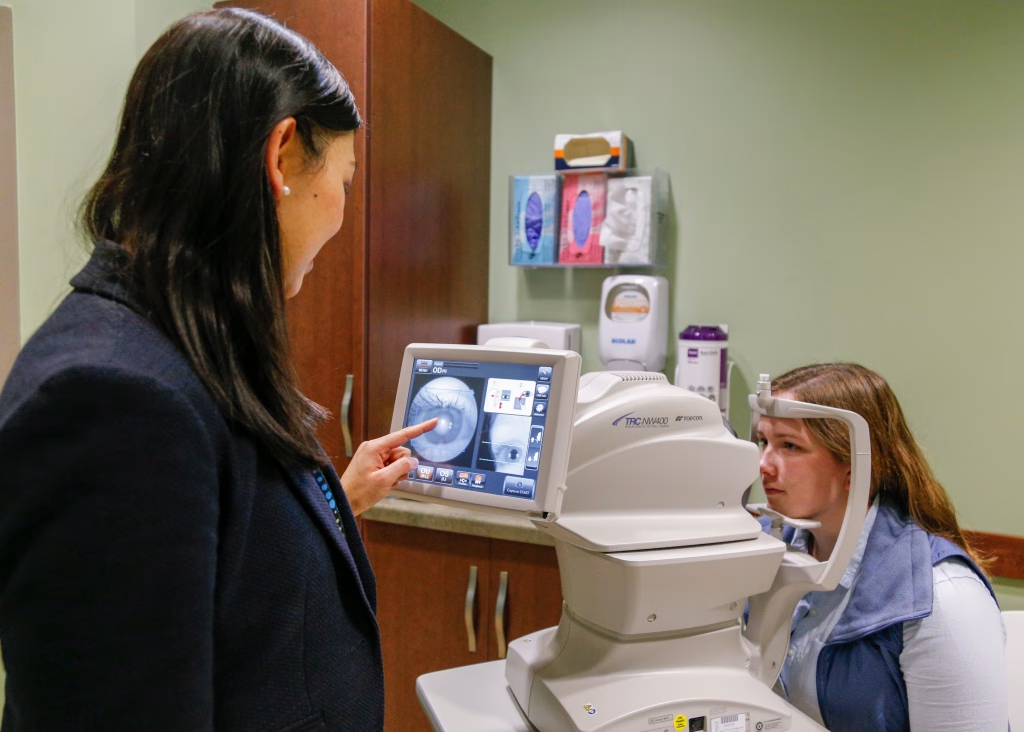
Increased screenings to prevent blindness
Principal Investigator: Yao Liu, MD, MS
Approximately 423,000 Wisconsinites have been diagnosed with diabetes. This condition can lead to eye disease that, if left untreated, may result in preventable blindness. Yet fewer than 70,000 receive the recommended yearly eye screening which can reduce the risk of blindness by over 90%.
With the help of funding from ICTR*, researchers were able to expand a program called I-SITE, which helps primary care clinics integrate preventative screening into their daily work. The program has been implemented in 13 health systems across 8 states, including 20 primary care clinics. Additionally, the implementation guide has been downloaded over 100 times.
Shortened hospital stays and improved senior mobility
Principal Investigators: Barb King, PhD, RN & Linsey Steege, PhD
Extended periods of bedrest during hospital stays can result in a fast decline for older adults. Mobilizing Older Adults via a Systems-based Intervention (MOVIN) is a program that helps improve patient mobility by working directly with nurses and addressing restrictions that prevent patients from walking independently.
With the help of ICTR’s Dissemination & Implementation Launchpad*, the program was adopted by the Wisconsin Hospital Association and has been implemented throughout the state. MOVIN has resulted in clinical, community, and economic benefits such as increased ability and confidence among nurses, increased quality of life among patients, improved resource allocation, and decreased length of hospital stay.


Using AI to enhance patient visits
Principal Investigators: Majid Afshar, MD, MS & Joel Gordon, MD
ICTR’s Learning Health System program worked with UW Health to evaluate the use of Ambient AI software during outpatient visits. This new technology makes notetaking easier for doctors, improving clinician well-being and creating a better patient experience. Since 2024, over 550 providers have used the Ambient AI software to take notes. Providers have shifted away from Virtual Scribe, dropping from 250 to 35 providers, cutting costs by $4.4M.
To help others follow suit, researchers recently published a practical playbook in the New England Journal of Medicine to help integrate Generative AI tools into health care workflows.
Learn more through coverage of this program from WISC-TV and UW Health.
Technology and data for customized care
New imaging technique for liver disease
Principal Investigator: Diego Hernando, PhD
Fatty liver disease, associated with metabolic dysfunction and obesity, poses major health challenges and leads to further liver injury in many patients, including fibrosis, cirrhosis, liver cancer, and liver failure. Currently 2 billion people globally and 100 million people in the U.S. are affected. Accurate, non-invasive tests are needed to enable diagnosis, staging, and treatment monitoring.
A new MRI technique developed by ICTR-supported researchers offers unprecedented precision to quantify fatty liver disease while also allowing patients to breathe freely during the imaging process. Not only does breathing freely benefit patient comfort, it is necessary for those unable to hold their breath for a prolonged time. Since 2024, nearly 1,000 patients have been scanned using this new method at UW Hospitals. Researchers are actively working with GE HealthCare, other makers of MRI equipment, and clinicians across multiple institutions to spread this technique more widely.


Using AI to prevent opioid misuse
Principal Investigator: Majid Afshar, MD, MS
ICTR’s Learning Health System program, together with UW Health colleagues, developed an artificial intelligence (AI) screening tool that successfully identifies hospitalized adults at risk for opioid use disorder. The tool alerts providers to recommend a referral to inpatient addiction specialists. Use of the tool reduced hospital readmissions and resulted in health care savings.
Compared to patients who received provider-initiated consultations, patients identified for addiction medicine referrals by AI screening and who received consultations had 47% lower odds of being readmitted to the hospital within 30 days after their initial discharge. The team calculated that each readmission avoided saved about $6,800 in health care costs during the study period, an estimated total of $108,800 in health care savings for the eight-month study period. The team’s research has been published in the journal Nature Medicine.
Read more in the newsroom
- An innovative approach to health care: Embracing the Learning Health System
- Pilot Award helps tobacco-cessation researchers leverage additional $10M to empower Black adults to quit smoking
- Translational Research Team Awarded $11M Grant to Advance Understanding of Idiopathic Pulmonary Fibrosis
- Learning Health Systems project grant awarded to effort to improve care for high-need, high-complexity patients
*Funding for this project was provided by the UW School of Medicine and Public Health from the Wisconsin Partnership Program through a Strategic grant awarded to the UW Institute for Clinical and Translational Research at the UW School of Medicine and Public Health.