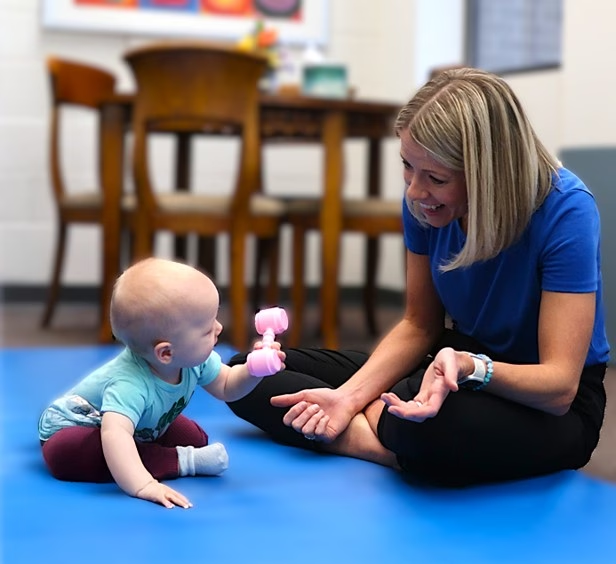
For more than a decade, Kellie Collins, PT, DPT, PCS, built her career around pediatric physical therapy, helping children and families through clinical care while nurturing a passion for teaching. Pursuing a PhD wasn’t just about switching careers, but a way to take her natural curiosity much further.
Without ICTR, Collins’ north star would likely have remained the same: becoming an educator. Instead, she discovered that research could strengthen her impact in the classroom and beyond.
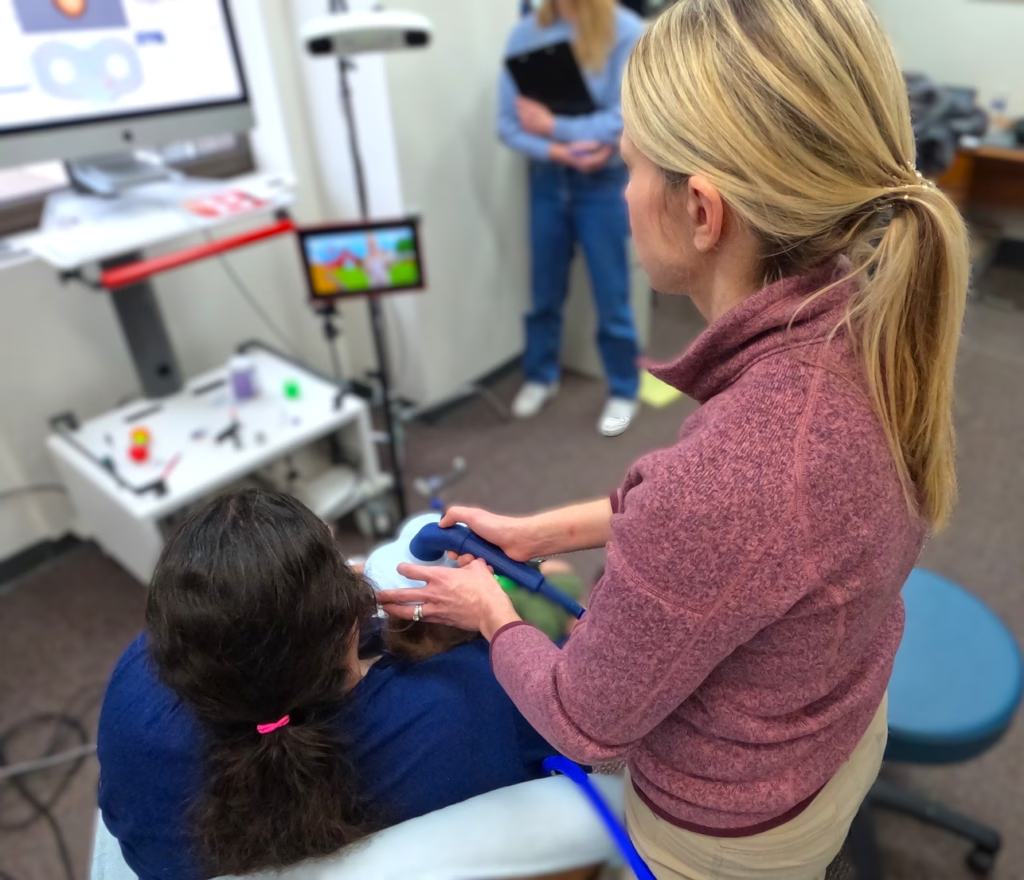
Kellie Collins uses single-pulse transcranial magnetic stimulation (spTMS) to assess corticospinal tract connectivity in an infant participating in the Baby Brain Recovery Study. This noninvasive research assessment evaluates motor pathway function by measuring muscle responses to magnetic stimulation of the motor cortex.
“I now see the roles of educator and researcher as complementary,” Collins said. “Research makes me a better teacher because I understand more deeply how evidence is generated, and teaching continually reminds me why communicating science clearly matters. My long-term goal is to be a faculty member in a physical therapy program where I can combine teaching, mentoring, and pediatric rehabilitation research.”
Encouraged by her mentor, Bernadette Gillick, PhD, MSPT, PT, Collins enrolled in ICTR’s Clinical Investigation Graduate Program. After 13 years as a full-time clinician, returning to school was daunting. Instead of viewing her clinical experience as something to leave behind, the program treated it as a foundation to build upon while providing training in critical areas such as study design, statistics, scientific reasoning, grant writing, and research methodology.
As a Clinical Investigation student, Collins was eligible to pursue the ICTR TL1 Predoctoral Trainee Program, which provides emerging researchers with protected research time, training, career development opportunities, and team science skills to help them function effectively within research teams.
“Its emphasis on developing future leaders in clinical and translational science aligned very well with the kind of researcher I was becoming,” Collins said of the TL1 Program. “The mentor meetings with ICTR leadership, monthly writing workshops, and the monthly curriculum, Launching Your Career in Translational Science Series provided regular opportunities to step outside of the day-to-day details of my project and think more broadly about my development as a scientist and where my work fits within clinical and translational research.”
The investment paid off. During her time with ICTR, Collins’ doctoral research led to national presentations, manuscripts, preliminary data for fellowship and grant applications, and external research support and recognition.
In 2025, she received the Outstanding Student Researcher Poster Award at ICTR Research Day for her work studying corticospinal tract organization in infants with perinatal brain injury.
“The recognition was exciting, but what stands out more to me is what that moment represented,” Collins said. “I was presenting research involving methods and concepts that had once felt completely outside my expertise as a physical therapist. Being able to explain the science, answer questions, and have the work recognized made me appreciate how much I had grown.”
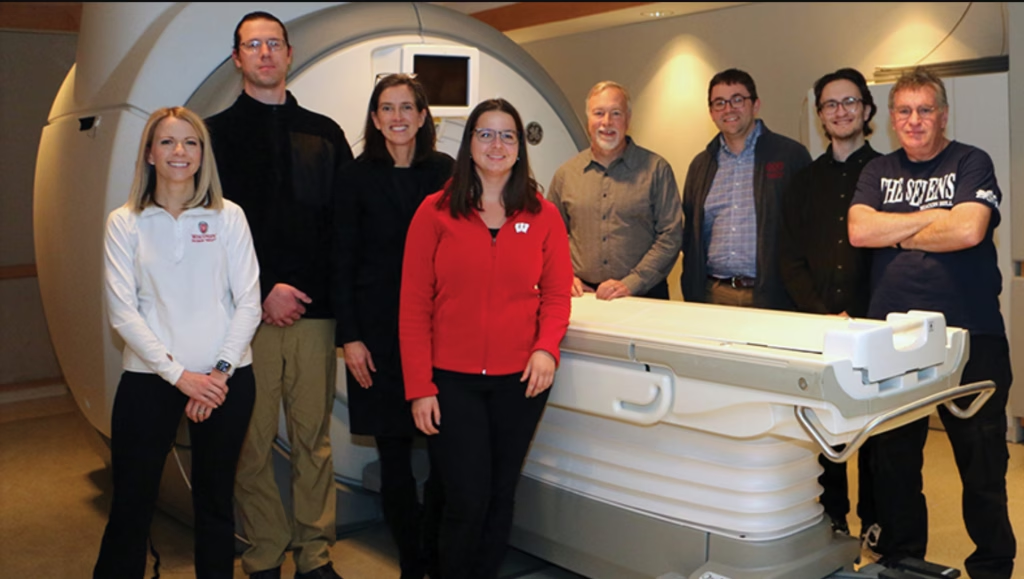
Kellie Collins (far left) and Bernadette Gillick (third from the left) with collaborators/colleagues.
That growth, Collins says, reflects the support of the people around her.
“I am incredibly grateful to my mentor, Dr. Gillick, who encouraged me to pursue this path in the first place and has continually created opportunities for me to grow. I have also benefited tremendously from the faculty and staff in our Pediatric Neuromodulation Laboratory, my collaborators, my fellow trainees, and the broader ICTR community. So many of the milestones I am proud of reflect that network of mentorship and collaboration.”
Today, Collins is pursuing the career she once envisioned, but with a broader perspective. She no longer sees teaching and research as separate paths. Her experience expanded her sense of what she could contribute and showed her how clinical expertise, teaching, and research can work together to create greater impact.
To learn more about the Clinical Investigation Graduate Program, visit the program webpage or reach out to program managers Beth Bierman and Deidre Vincevineus. To learn more about the TL1 Program, visit the program webpage or contact program manager Katrina Bell.