In a PhD program, students are accustomed to having structure, direction, and a mentor to help prioritize direction. The postdoc stage, however, is a different landscape. A postdoc is generally a short-term research position that provides further training in a particular field. It’s an opportunity to develop independence, hone technical skills, and focus research interests.
Postdocs are expected to step into independence quickly, taking ownership of their research while navigating short-term positions and an increasingly competitive academic job market. Many also arrive at this stage of their careers having already navigated many challenges, such as facing adversity in personal and academic aspects of their lives and/or having limited access to academic resources.
AHEAD, an initiative in the Pathway Program, was created to address these challenges. It’s designed to support scholars’ well-being while helping them build leadership and translational research skills. It provides a cohort experience for scholars and addresses the gaps in professional support and training that many postdoctoral scholars experience.

Hanna Barton presenting at a poster session.
For scholars like Hanna Barton, PhD, it became a space to reflect, connect across disciplines, and examine what it means to grow as an independent researcher.
Barton, a scientist and former postdoctoral scholar in the BerbeeWalsh Department of Emergency Medicine, has built a career out of asking hard questions about how complex systems work—and how they could work better. Starting as a biomedical engineering undergrad at UW–Madison, Barton quickly discovered a passion that extended beyond circuits and product design. An introductory course in public health and a course in human factors engineering redirected their path, inspiring them to think broadly about how our society, organizations, and built environment can best support our well-being.
Today, Barton’s work is all about studying the messy, complicated realities of health care. “I get to dig around in big system problems,” they said, describing the fascination that’s fueled much of their work. “I want to understand what keeps the system functioning the way it does—and what we can do to change it.”

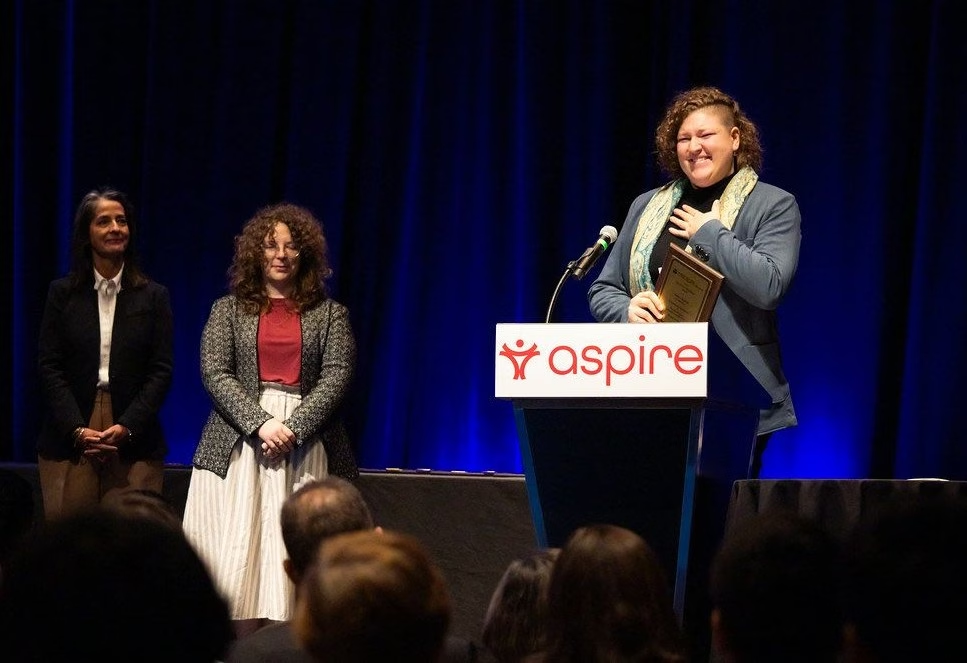
Hanna Barton (right) receiving the Human Factors and Ergonomics Society 2025 Health Care Early Career Award
What Barton found in AHEAD was not simply professional development programming; it was a room full of scholars navigating the same complex situation. The cohort represented a wide range of disciplines, yet everyone brought the same questions, anxieties, and roadblocks.
“These people were experts in fields that had almost nothing in common with my own,” Barton said. “But they were all dealing with the same stuff. That was the cool part. The problems we faced weren’t necessarily tied to a discipline.”
Participants could see their challenges reflected through different lenses. Discussions about writing blocks, procrastination, and being overwhelmed—often the “forever problems” of academic life—helped normalize the fact that even high-achieving scholars struggle with the pressure to produce. “You learn that no one has actually solved these problems,” Barton said. “But it is meaningful to talk about them with people who get it.”
Redefining mentorship during the postdoc years
The postdoc experience also pushed Barton to rethink how mentorship works at this stage of their career, and what they needed in order to thrive academically and personally. Barton realized they wanted to broaden their mentor network—continuing to partner with their postdoctoral advisor while also looking for mentors in adjacent fields, as well as with peers at different career stages.
This is where the AHEAD program helped Barton. Through seminars led by a range of scholars all working in translational science, coupled with opportunities to connect with other postdoctoral scholars across UW, Barton mapped out different kinds of mentoring they needed and built a network of mentors, each offering a different type of guidance.
“There’s this perception that a mentor is one person who can do everything,” they said. “But the reality is, you need different people for different things. Understanding that prevents both sides from feeling like they’re failing.”
Advice for future AHEAD applicants: Show up fully

Hanna Barton (right) receiving an award for best lightning presentation at WisconsINFORMATICS 2025.
Asked what they would tell someone considering joining the AHEAD program, Barton didn’t hesitate: apply, but don’t sit quietly on the sidelines. “Bring your real challenges,” they said. “Yes, it’s scary to be vulnerable. But everyone in that room is growing. And when you open up, you’re met with care.”
The reward for that vulnerability, Barton believes, is the heart of what makes AHEAD transformative. It’s not just skill‑building and networking. It’s learning to trust yourself, your peers, and the messy process of becoming an independent researcher.
Funding for AHEAD was provided by the UW School of Medicine and Public Health (SMPH) from the Wisconsin Partnership Program through a strategic grant administered by the SMPH Office of Basic Research, Biotechnology and Graduate Studies.