Increasingly, doctoral degrees (MD and PhD) are being earned by degree-seekers following nontraditional paths, balancing part-time study with careers, families, and personal challenges.
For Joanne Yee, a speech-language pathologist at the William S. Middleton Memorial Veterans’ Hospital in Madison, the journey to a PhD was fueled by a sense of purpose and supported by the ADEPT program. ADEPT is one initiative within the Pathway Program, which supports the mentorship and professional development of scholars conducting clinical and translational research.
Yee works with patients experiencing swallowing difficulties due to cognitive impairment or dementia, and she leads a national program aimed at improving dysphagia care outcomes for veterans titled the Veterans Swallowing Health and Clinical Practice Excellence (Vet-SHAPE) program. Her clinical experiences inspired her to pursue a part-time PhD in clinical investigation at UW–Madison, one of several graduate and certificate programs supported by ICTR.
In May 2025, Yee advanced to doctoral candidacy. Her dissertation focuses on how speech-language pathology interventions can better support individuals living with dementia—particularly in managing swallowing challenges proactively.
Choosing a part-time doctoral program allowed Yee to continue her impactful work with patients—work that also provides valuable lived experience that drives her research direction.
She works with many clinicians who strive to provide accurate rehabilitative care for swallowing issues. Still, the treatment regimen and timeline for when a patient might see benefits are often unclear. “Clinical trials can lead to meaningful outcomes for individual patients,” Yee explains, “but they don’t always translate into tools or systems that clinicians can use to fully support their patients.”
Yee hopes her research will help drive systemic change, elevating the role of speech-language pathologists in patient care and providing patients with peace of mind that they are supported throughout their health journey.
Participating in the ADEPT Program
Navigating a part-time PhD while working full-time isn’t easy. Maintaining momentum while shifting between schoolwork, clinical work, and personal life can be challenging. Some, like Yee, also find a lack of community among part-time students. A desire for a supportive community was one of the reasons she applied for the ADEPT Program.
Currently, few UW–Madison training programs support nontraditional pathways to earning a doctoral degree. ICTR created ADEPT to fill that gap, and scholars like Yee are demonstrating just how transformative that support can be.
Funded by the Wisconsin Partnership Program and administered by ICTR, ADEPT is a mentored professional development program that supports part-time PhD students enrolled in a graduate program focused on clinical and translational research. ADEPT provides a supportive environment for career development and opportunities to connect with leaders in the health sciences.

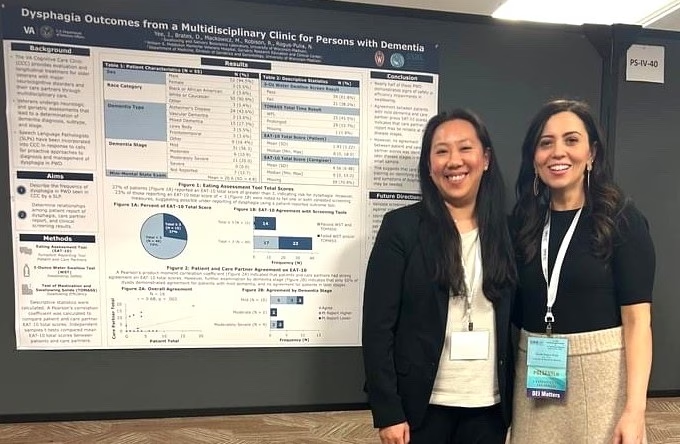
Joanne Yee (right) with her mentor, Nicole Rogus-Pulia at the Dysphagia Research Society Annual Meeting.
Yee found more than just community in ADEPT. She gained access to mentorship resources, tools to help with writing, and a supportive environment with other scholars she could bounce ideas off of and discuss how to manage classes, time, and motivation.
“It’s been a really wonderful and validating experience and beyond what I ever would have anticipated,” Yee explains.
Beyond the valuable resources and support from the ADEPT team, Yee credits her mentor, Dr. Nicole Rogus-Pulia, with helping her see the possibilities of doctoral study: “She’s a very encouraging person, strong advocate, and instrumental in helping me see the possibilities and benefits of pursuing a PhD.”
If you ask her mentor, Joanne’s journey is proof that nontraditional paths can lead to incredible impact.
“Joanne exemplifies the profound impact that clinicians with rich lived experiences can have when pursuing advanced research training. Through the ADEPT program, I’ve seen her balance full-time clinical practice with part-time doctoral studies—advancing to candidacy, earning awards, and advancing research for systemic improvements in patient care. Joanne inspires nontraditional scholars: embrace your unique strengths, seek supportive networks, and persist—the field needs your voice for translational change,” said Rogus-Pulia.

Joanne Yee at the Dysphagia Research Society Annual Meeting.
Yee’s work has already gained recognition. In January 2024, she presented a poster and lightning talk at ICTR’s first Research Day, where she received an award for best graduate student poster. She also received a New Investigator Award at a major dysphagia research conference, and received the Sumiko Okada Scholarship, which enabled her to travel to Japan to present on cough and respiratory health in patients living with dementia.
She attributes part of her success to the writing support and storytelling tools she accessed through ADEPT.
“If you’re thinking about applying [for ADEPT], my advice is: absolutely go for it. I think we often discount the stories or lives that brought us here,” she says. “But those lived experiences are strengths. Every applicant brings something valuable to the table. Those lived experiences are often missing from academic spaces, and they’re essential for creating meaningful, realistic change.”
Funding for ADEPT was provided by the UW School of Medicine and Public Health (SMPH) from the Wisconsin Partnership Program through a strategic grant administered by the SMPH Office of Basic Research, Biotechnology and Graduate Studies.